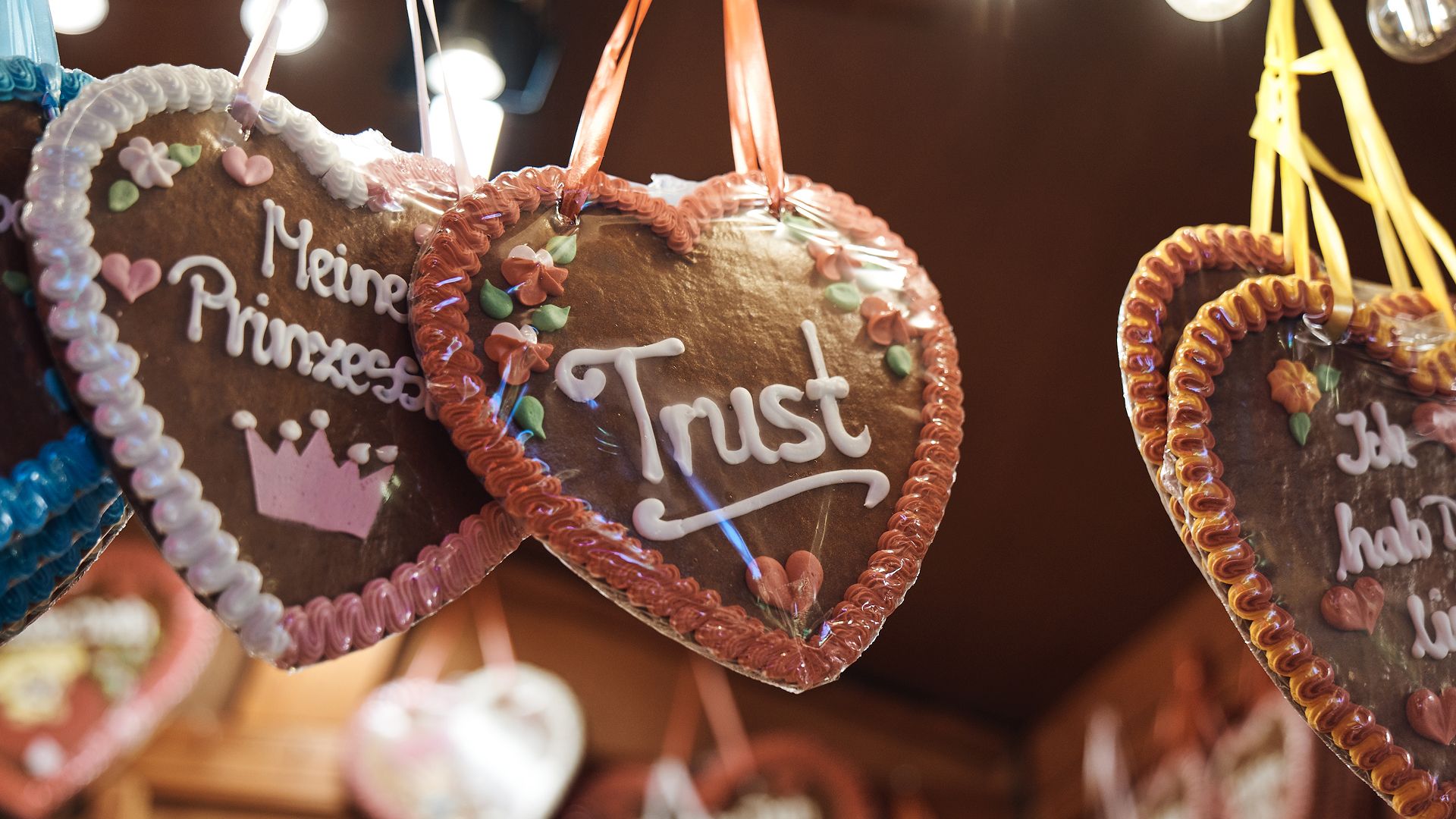
Trust is often dismissed as a 'soft skill', yet it remains the hardest currency of any brand. But how does one become – and, more importantly, remain – credible?
In English, the term 'trust' has a remarkable duality. It denotes the reliance between individuals, and at the same time, it refers to a legal investment instrument designed to secure assets across generations. A well-managed brand performs essentially the same function: it safeguards the value of an organisation, protects it from erosion through indifference, and passes it on.
What numbers say about trust
Trust, therefore, is not a soft factor but a solid economic variable. For decades, transaction cost economics have demonstrated that trust reduces the administrative, negotiation, and security overheads that companies would otherwise have to invest in every business relationship. According to Great Place to Work, companies with high trust capital achieve up to 8.5 times higher value creation per employee than the market average. Over several decades, the most trusted companies in the Great Place to Work ranking outperformed the shareholder returns of the broader market by a factor of 3.4. The effect is all the more dramatic when this trust is lost.
A stark example of this is the Volkswagen Group. The emissions scandal, uncovered in 2015, cost the group more than 33 billion euros in fines, settlements, and legal costs according to their own reports. This figure does not include the loss in brand value, which Brand Finance estimated at 10 billion US dollars immediately after the news broke. The company had built its identity on engineering integrity. When this proved to be a fallacy, the damage was proportional to the trust that customers and shareholders had placed in the brand.
Where trust has an impact
Trust exerts its immense power not 'only' in customer relationships, but in virtually all areas of corporate activity:
- Employees: Trust in the company strengthens identification, productivity, and the willingness to contribute ideas.
- Innovation: Transformation projects succeed where a culture of trust creates the necessary scope for manoeuvre.
- Investors: Companies with a stable base of trust find it easier to obtain capital and secure better terms.
- Supply chains: Trust-based networks operate more efficiently and react faster to change.
- Corporate transformation: Those who possess trust can lead change credibly and reduce resistance.
- Artificial Intelligence: Trust determines whether employees, customers, and investors accept or reject new technologies.
So much for the theory. In practice, there is a significant gap between a company's self-perception ("We are trustworthy") and its external perception. According to a PwC survey, 90 per cent of business executives believe that customers place great trust in their company. Yet, only 30 per cent of the customers themselves say so. This gap is not created by poor communication; it arises where a company does not know clearly enough who it is and what it stands for.
What truly generates trust
Trust is not an attribute that a company can simply claim for itself. It emerges in the mind of the observer as a conclusion based on repeated experiences. Neuropsychology is unambiguous here: the brain stores experiences of reliability and security and gradually builds trust from them. This process cannot be shortcut or mandated. The result must be earned repeatedly.
Patagonia illustrates this most clearly. Since its founding in 1973, the company has made ecological responsibility the core of its business and has aligned everything from product development to the supply chain and ownership structure accordingly. When founder Yvon Chouinard transferred the entire company to a non-profit trust in 2022 and earmarked all future profits for environmental purposes, it was not a repositioning. It was the consistent continuation of a stance that the company had demonstrably upheld for nearly five decades. Customers believed it because they had experienced it time and again. What Patagonia has built over decades was and is not a communication strategy, but the identity of the company itself.
There are also convincing examples in Germany. Trumpf, founded in Stuttgart in 1923 as a mechanical workshop, remains family-owned to this day. This structure has shaped its behaviour over generations: a consistent focus on engineering quality rather than short-term returns, and a human-centric corporate culture that enables, for example, flexible working hours tailored to different life stages. Customers in more than 100 countries have gathered enough experience with this reliability to trust the brand across very different business areas. The identity has held because the behaviour behind it has held.
Such an identity grows out of what a company does, how it makes decisions, and the people it attracts. The task of management is to uncover it and develop it in a contemporary way.
Trust as a leadership task
This assumes that management is prepared to face uncomfortable questions. What truly defines us? What have we delivered on in the past, and what have we not? Where do our aspirations and reality diverge?
The collapse of Credit Suisse in 2023 demonstrated the consequences when these questions are not asked. A global reputation built over 150 years was eroded by repeated scandals, management failures, and strategic contradictions to such an extent that the bank could not be saved, even with state intervention. The Swiss Financial Market Supervisory Authority (FINMA) stated: the trust of customers, investors, and the markets had been irrevocably lost.
Identity must therefore be nurtured and adapted to changing environments without losing its core. Those who invest in this process create a level of trust that endures through all crises and transformations.
Hannes Müller
is a Strategy Director at Strichpunkt Identity in Basel and a fan of Elan. The Slovenian ski brand embodies technological progress while remaining true to its founders' philosophy.